
When Being Different Feels Like Defeat
There are moments when we start to question how we were made.
Why we think the way we do. Why we move slower, feel deeper, or see things others overlook.
It can feel like something is wrong with us, as if we are missing the quality that makes others easily fit into the world. But being different does not mean being deficient. The world has simply created a hierarchy of traits suited to its pace, not necessarily its purpose.
Then I came across a verse in the book of Job describing the ostrich, and I was struck by how much truth it holds for those of us who move differently:
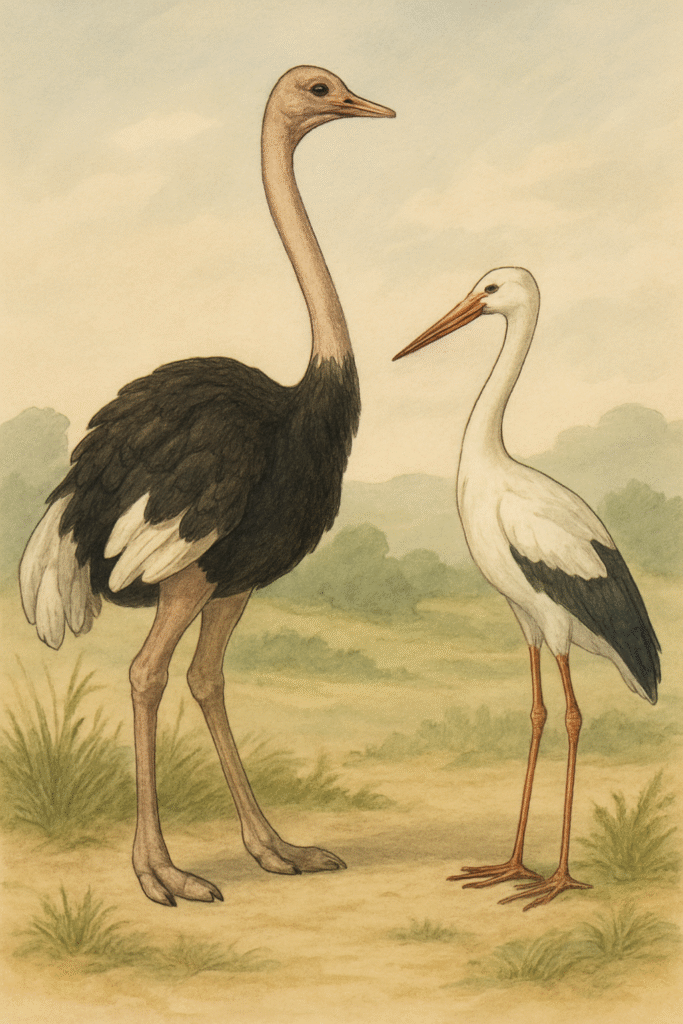
“The wings of the ostrich flap joyfully, though they cannot compare with the wings and feathers of the stork… Yet when she spreads her feathers to run, she laughs at horse and rider.”— Job 39:13–18
The ostrich and the stork both have wings, yet only one can fly. The other runs across the desert at forty miles an hour. Both are perfectly designed for their purpose, though neither can do what the other does.
The question is: which one are you trying to be?
The Ostrich’s Design
The ostrich is often used as a symbol of foolishness — too heavy to fly, too careless with its young, and not clever enough to survive without divine intervention.
Yet, that same ostrich can outrun a horse, defend itself with powerful kicks, and survive in extreme conditions where few others can.
The design isn’t broken; it’s different.
We live in a culture that measures worth through comparison. We want the intellect of the eagle, the grace of the swan, the reach of the stork.
But we rarely stop to ask what would happen if the ostrich tried to fly instead of run. It would die of exhaustion.
Self-awareness is the antidote to that exhaustion. Knowing your own design—and living from it—is one of the highest forms of wisdom.
When “Fitting In” Becomes Self-Erasure
In one organization I worked for, “speed” and “innovation” were the ultimate measures of success. Everything was urgent. Everyone was expected to think fast, move fast, and deliver results even faster.
As an HR strategist, I noticed how this culture rewarded visible busyness over thoughtful execution. People were praised for quick decisions, even when those decisions created chaos later. There was little space for reflection, compassion, or learning.
At first, I tried to adapt. I forced myself to move at their pace. I spoke faster, worked longer, and said yes to everything. But over time, I felt the quiet erosion of clarity. Mistakes multiplied. The team was stressed and disconnected.
Eventually, I began to question what kind of “innovation” comes from exhaustion. I introduced mindfulness practices and encouraged intentional pauses in meetings—simple rituals to restore focus.
The reaction was not what I expected.
“Too slow.” “Not urgent enough.” “We’ll lose our edge.”
In that moment, I realized I may be an ostrich among storks. My way of thinking wasn’t valued because it didn’t look like movement. Yet it was the kind of movement that could have saved us from burning out entirely.
The Quiet Cost of Abandoning Yourself
It’s easy to betray ourselves in the name of belonging. We start editing how you speak, what we value, even what we believe.
The slow unspooling of authenticity begins the moment we decide that fitting in is safer than being misunderstood. But authenticity has a way of calling us back. Sometimes through discomfort. Sometimes through failure.
For me, it came after a mistake that exposed the fragility of the culture I had been trying to fit into. That mistake was painful, but it was also clarifying. It reminded me that I was never meant to thrive in an environment built on fear and speed. I was meant to lead from reflection, not reaction.
When I returned to myself—my natural rhythm, my way of thinking, my quiet strength—I realized how much of my energy had been spent pretending to fly when I was made to run.

Embracing Difference as Divine Design
Every human is designed for a particular kind of movement. Some thrive in motion and noise; others in stillness and thought. Both are essential.
The stork and the ostrich are not in competition. They simply exist in different environments. The tragedy occurs when the ostrich tries to leap into the sky or when the stork attempts to race across the desert.
The truth is, we all have our deserts and our skies. The challenge is learning to identify which one belongs to us.
Authenticity isn’t about rebellion or defiance; it’s about harmony with one’s nature. It’s the alignment between what we are and what we choose to express.
Lessons from Alan Watts on the Symphony of Difference
Alan Watts once said that the universe works like an orchestra. Each instrument has a sound that contributes to the whole. You can’t replace the violin with a drum or expect the flute to match the cello’s tone.
Similarly, society needs thinkers and doers, the intuitive and the analytical, the bold and the gentle. Each fills a gap that no one else can.
But when we compare, we silence the music.
Inclusion, in its truest form, isn’t about tolerating differences; it’s about recognizing we need them.
The introvert’s caution is as valuable as the extrovert’s enthusiasm, and the visionary’s risk is balanced by the strategist’s restraint.
When we start to see our differences as necessary, not flaws, we begin to live from power rather than shame.
The Courage to Stay Aligned
Being authentic often feels lonely because it takes the courage to stand apart. Society praises individuality until it’s inconvenient. People say, “Be yourself,” but what they often mean is, “Be yourself—just not like that.”
Staying true to your design requires discernment and faith. Not necessarily religious faith, but trust in the wisdom that created you. There’s a quiet intelligence in how life forms each of us. When you learn to trust that intelligence, the need to seek approval diminishes.
Authenticity isn’t a performance; it’s a practice. It’s the daily choice to show up as yourself, even when the world says another way would be easier to digest.

You Are Not Broken
The ostrich teaches us that wisdom isn’t always intellectual, and strength isn’t always visible.
You might not be the fastest thinker or the loudest voice in the room. You may take longer to understand, heal, or create. But when your moment arrives, you move with a depth that only self-awareness can bring.
You are not broken. You are built for a specific kind of excellence that may not be obvious to those busy chasing something else.
The world measures performance. God—or the quiet intelligence of life—measures purpose.
You were never meant to be everything to everyone. You were meant to be fully yourself.
Reflection Prompt:
– What part of yourself have you tried to suppress because it doesn’t match the world’s pace or expectations?
– When do you feel most in sync with who you truly are?
– What might it look like to honor that rhythm this week?
Call to Action
If this reflection resonates, share it with someone learning to embrace their differences. Follow Ms. Normal for more conversations about authenticity, growth, and living intentionally.