Some sayings sound so simple that we dismiss them too quickly.
“Do not test a depth you never reached with both feet.”
It sounds like something an elder would say while peeling oranges in the backyard. Familiar, worn, and almost too obvious to be profound.
But the older I get, the more I realize that many clichés became clichés because people kept surviving long enough to confirm them.
At its core, this saying is about caution. It is about not throwing your full self into something you do not understand. Not with both feet. Honestly, not even with one careless foot.
It is about slowing down before taking action, especially when the consequences could change your life in ways you cannot easily undo.
And if we are honest, most of us have violated this wisdom at some point.
We jumped into relationships we did not fully understand. We entered situationships, hoping vibes would do the work that clarity should have done. We joined gossip, conflict, or feuds about people and situations we barely knew. We made emotional decisions first and asked sensible questions later.
I have done it too.
But the latest escalating conflict involving Iran, the U.S., and its allies brought this cliché back into sharper focus. The kind of moment that forces everyone to pause and ask: are we stepping into deep waters unknowingly?
Because sometimes the real shock is not what landed.
It is what could have.
When the Real Lesson Is Underestimation
War is tragic. Always.
The people who suffer most are usually ordinary people who did not ask for it, did not design it, and cannot control it. And while the human cost is heartbreaking, I would be lying if I said there was nothing to learn from it.
Recent reports indicate that Iran launched two ballistic missiles toward the joint U.S.-U.K. base on Diego Garcia in the Indian Ocean. Neither missile hit. But the deeper concern was not the miss. It was what the attempt revealed.
Iran may be capable of striking much farther than many believed. Far beyond the 2,000 km range it had long emphasized.
That changes the conversation.
Because this is not just about impact. It is about capacity.
It signals a shift. A widening of possibility. A reminder that what we think we understand is often only a fraction of the full picture.
And that is how escalation begins.
Not always with what happens.
But with what becomes possible.
And the lesson for the rest of us watching from afar is this:
Never assume something is small simply because it looks small to you.
Never assume weakness because you have not yet seen the full capacity.
Never step boldly into a depth you have not measured just because your ego told you the water looked shallow.
That is not only a lesson for countries.
It is a lesson for relationships. Arguments. Workplaces. Families. Friendships. Everyday life.
Because people do this all the time.
We size people up by appearance. By tone. By status. By accent. By softness. By silence. By how they present themselves.
And then we tell ourselves a story.
I know who this person is.
I know what they are capable of.
I know how far I can push.
That kind of confidence has embarrassed many people.
The Day I Saw “Do Not Test the Depth” Play Out in Real Time
One day, I was sitting at a red light when I witnessed something I still have not forgotten.
A car pulled up two lanes away. A petite Black woman was in the driver’s seat. Thick glasses. Calm face. Nothing about her seemed unusual. She just sat there waiting for the light.
Then another car pulled up aggressively beside her.
A taller, bigger woman jumped out from the passenger side and stormed toward the first car. She was yelling, cursing, agitated. Clearly, something had happened earlier on the road that had enraged her. But by the time I saw the scene, all I knew was what was in front of me.
The petite woman remained in her car.
Then the aggressor started trying to force the door open. She banged on the side window and motioned for the woman to come out.
Still, the woman inside did not move.
Moments later, the man driving the second car also got out. Now both of them were at her car, trying to force the door open.
That light changed, the car in front of the petite woman moved, and she moved too. Then suddenly, she reversed hard and fast, directly into the man and woman. Both were knocked to the ground, and she sped off.
Chaos.
People jumped out. Someone called 911. Police came. Ambulance came. I gave brief witness details. Then traffic cleared and I drove away shaken.
To this day, I do not know the full story. I did not know what had happened before that intersection. Maybe there had been a serious exchange on the road. Maybe the woman in the car had provoked something. Maybe not.
But here is what I do know.
From where I sat, what I witnessed was a couple stepping out of their vehicle on a public road to threaten a woman who was alone in her car. They tried to force her door open. Whatever had happened before, they crossed into dangerous territory the moment they turned themselves into roadside enforcers.
And in that moment, they misjudged the depth.

Never Judge a Book by a Quiet Cover
My private theory?
The couple saw a small, quiet-looking woman and assumed she would fold.
They saw size difference. Number difference. Maybe class difference. Maybe energy difference.
They thought, We are two. She is one. We can intimidate her. We can press her. We can make her answer to us.
What they may not have considered is that a person can look timid and still be capable of something extreme under fear, panic, or calculation.
That is the thing about human beings. Everyone has a line. Everyone has a capacity you may never see until you push too far. Some people manage their chaos well. Some restrain it. Some bury it. And some, when cornered, become very strategic with it.
A mosquito is tiny, but try sleeping in a room with one.
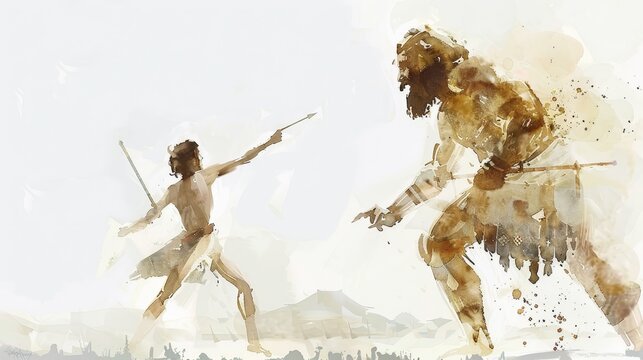
David was small too.
So yes, never judge a book by the cover. But also, never weaponize your assumptions about what the cover means.
Righteous Rage Can Still Ruin You
Now let me say this carefully.
Anger is not always wrong.
Sometimes anger is justified. Sometimes people really have harmed us. Sometimes injustice is real, visible, and painful. Sometimes your blood rises because something inside you knows a line has been crossed.
But justified anger does not automatically produce wise action.
That is where many people get into trouble.
They feel morally right, so they start behaving recklessly. They stop seeking resolution and start seeking domination. They stop wanting justice and start wanting to punish. Their emotions crown them judge and jury, and suddenly, process no longer matters.
That is dangerous.
Because the moment you step outside process, you are no longer just responding to injustice.
You are now participating in it.
Some people serve judgment like ice cream, scooping it out generously as though they alone were appointed to hand it out.
But judgment is not a light thing to carry.
My grandmother used to say there’s conventional justice, universal justice, and divine justice—and there’s a reason justice is blind.
Because the moment you call one judgment on another, you invite all judgment on yourself too.
Not always immediately. Not always in the same form.
But it comes.
Another version says when you point one finger, the others point back at you, so make sure your hands are clean.
Same lesson.
So before you move aggressively against another person, pause.
Ask yourself:
Am I seeking justice… or am I trying to feel powerful?
Am I correcting a wrong… or reacting from ego, hurt, or control?
Am I prepared to be judged by the same standard I am about to apply?
Because once you step into that role, once you decide to act outside restraint, you are no longer testing the situation.
You are stepping into a depth.
And not all depths let you come back unchanged.
Before You Test the Depth
Knowing all this is one thing.
Applying it in the moment is another.
Because when you are upset, offended, threatened, or convinced you are right, that is when you are most likely to act without thinking.
That is when you need to step back the most.
Ask yourself:
What is really happening here?
What might I be missing?
What story have I already told myself?
Is my anger leading me… or misleading me?
What is the lawful, conventional, or wise way to respond?
What are the consequences if I take matters into my own hands?
If this same action were turned against me, would I still call it fair?
What depth am I assuming is shallow simply because I have not yet seen the bottom?
These questions will not always feel natural in the moment.
But they can save you from regret.

What America, the Couple, and the Rest of Us Can Learn
On the geopolitical side, diplomacy remains the sanest path, even when it is frustrating, slow, and imperfect. Analysts and recent reporting continue to point to negotiated de-escalation, backchannel talks, and renewed agreements around Iran’s nuclear program and sanctions relief as more realistic paths than a wider war.
On the road rage side, the answer was simple, even if emotions were not.
Stay in your car.
Get the plate.
Call 911.
Report the incident.
Do not become the law because you are angry.
Do not turn outrage into physical confrontation.
Do not force a depth you do not understand to reveal itself the hard way.
And for the rest of us?
Be slower to assume.
Be slower to charge.
Be slower to judge.
Be slower to provoke what you are not prepared to survive.
Some waters do not look deep until you are drowning in them.
Final Thoughts
There are people, situations, and conflicts that look manageable from a distance. They look small. Soft. Limited. Predictable.
Then you step in, and suddenly you realize the floor is gone.
That is the danger of pride. It convinces us that confidence is the same as understanding.
It is not.
Wisdom knows how to pause. Wisdom knows how to observe. Wisdom knows that not every offense requires a reaction, not every suspicion requires intervention, and not every battle that can be entered should be entered.
So yes, the saying is old. Yes, it sounds cliché.
But it is still true.
Do not test a depth you never reached with both feet.
Some lessons are too expensive to learn firsthand.
Call to Action
Have you ever misjudged a person, a situation, or a risk and learned the hard way that there was more beneath the surface than you realized? Share your story in the comments. Someone else may need that reminder today.
And if this post spoke to you, send it to someone who needs a gentle warning: caution is not weakness. Sometimes it is the highest form of wisdom.